
How Long Does It Take to Learn AI for My Business?

Plan on 4 to 6 hours a week as a minimum. My 52-hour build replaced three paid tools and kept getting faster. Here is what that actually looks like.

Plan on 4 to 6 hours a week as a minimum, every week you are building, and expect the payoff to build over months rather than overnight. That covers learning the tools, building something, fixing what breaks, and understanding it well enough to explain it to your team. A weekend course can start you off, but the real learning happens in the weeks after it ends.

The honest answer to how long it takes

The question people ask is usually shaped wrong. They want to know how many hours before they are "done learning AI." The better question is how many hours before they are building something that works.

Recently I built a system in 52 hours spread across just over a week. That was Colorado Springs Magazine's Top Attorneys nomination and recognition platform, which replaced Mailchimp, SurveyMonkey, and GoHighLevel for that one program. One platform handled attorney nominations, survey data, ballot voting, email sequences, and the final recognition list.

If I were still at the beginning, that same system would have taken a month or two, with a lot of errors and dead ends along the way. That gap is what the learning curve actually buys you.

The 52 hours included:

  • Reading documentation and watching walkthroughs on the tools
  • Writing prompts and iterating on them
  • Building the actual system
  • Debugging what broke
  • Testing it against real data before it went live

That is not 52 hours of passive learning. It is 52 hours of doing something that had to work by a deadline.

What the 52 hours actually replaced

Before you freak out about the investment, you need to understand the full economics, because the savings are greater than the cost. The traditional build estimate for the same system came in between $65,000 and $140,000. We built it for approximately $10,840 total, counting development time and AI usage costs.

The annual subscription savings from replacing those three tools came to $2,600 a year. The staff time savings were larger: roughly 120 hours a year that had been spent moving data between three disconnected systems. When you have one record per person instead of three separate lists that have to match up, a lot of manual work disappears.

Now think about what that 52-hour build actually cost in time. At a reasonable rate for a business owner's time, that is roughly a one-time investment. And what does it cost to run going forward? Next to nothing. The system is built. And that cost only compounds in your favor over time.

That is what the time investment bought. Not a certificate. Not a credential. A working system that runs every year with less effort than the old way required.

What the learning curve actually looks like week by week

The first few weeks feel slow. You are building vocabulary more than systems. You learn what a prompt is, what context matters, what the tools can and cannot do. You make a lot of things that almost work.

Around weeks four through eight, something shifts. You start seeing the pattern. You understand why the last thing broke and you know how to fix it before you even start the next one. The gap between what you imagine and what you can build starts closing.

By month three, if you have been consistent, you are not learning how to use AI anymore. You are deciding what to build next.

The 4 to 6 hours a week number matters because it keeps that momentum going. Less than that and each session starts from cold. You spend the first hour remembering where you were instead of moving forward.

The part most people skip over: security

This is where I slow people down when they want to move fast.

Veracode's October 2026 GenAI Code Security Report found the average security pass rate across 18 AI models was 62 percent. That means roughly 38 percent of AI-generated code contained vulnerabilities without extra verification steps.

That number matters most when you are building anything that touches customer data. Email systems, survey platforms, payment flows, login systems. The AI will write code that works in the demo and fails in a way you cannot see until it matters.

What that means practically: before you start building anything that stores or transmits personal data, you need security rules set, and you need a person reviewing the work who understands what they are looking at. That is a skill you either develop or bring in.

I rebuilt the Colorado Springs Magazine email system without deep technical expertise because the hard part there was knowing what to send and what data I wanted back. The nomination platform was different. That stored attorney contact information, ballot data, and survey responses. That required someone who could verify the AI's work at the code level.

Do you need technical skills to do this?

It depends entirely on what you are building.

Content systems, email workflows, internal documentation, research processes, customer communication drafts: you can build most of this without a technical background. The hard part is knowing your business well enough to know what you actually need.

Anything that stores customer data, handles payments, integrates with your CRM at the API level, or has to stay secure requires either technical knowledge or someone with it reviewing the work. You cannot outsource that judgment to the AI.

The honest version: most business owners can learn enough to build operational AI systems in their own company. They hit limits when they try to build systems that need to be secure or that need to scale beyond what they personally can maintain. That is when outside expertise matters.

Should you learn it yourself or bring in help?

Both, usually.

You still need to learn enough to run AI inside your business. No outside person can do that for you permanently. The decisions about what to automate, what to leave alone, how to explain AI outputs to your team, and how to catch mistakes: those require understanding, not just access.

What a fractional AI officer does is build the first system with you, train you as you go, and stay as long as you need. Some owners keep that support ongoing as the landscape changes. Others fade it out once their team can run things in-house. Either approach works if the goal from the start is transferring capability, not creating dependency.

The 4 to 6 hours a week does not stop when the first build is done. That is the ongoing cost of staying current in a field that is moving fast enough that last year's best practice is already outdated.

The number that matters most

Not 52 hours. Not $10,840. Not 62 percent.

The number that matters is how many hours you have been putting in and what you have built with them. That is the only measure of whether the time is working.

Frequently Asked Questions

How long does it take to learn AI for my business?

Plan on 4 to 6 hours a week as a minimum, every week you are building. Expect the payoff to build over months rather than overnight. A weekend course can start you off, but the real learning happens in the weeks after it ends, when you are building something that has to work.

Do I need technical skills to build with AI?

It depends on what you are building. Content systems, email workflows, and internal documentation do not require a technical background. Anything that stores customer data or has to stay secure needs someone who understands the technology stack and can check the AI's work.

How much does it cost to build a custom business system with AI?

Colorado Springs Magazine's Top Attorneys platform cost about $10,840 to build, including development time and AI usage. A traditional build of the same system was estimated at $65,000 to $140,000. Your cost depends on the scope of what you are replacing.

Can a custom AI-built system replace tools like Mailchimp, SurveyMonkey, and GoHighLevel?

In Colorado Springs Magazine's case, yes. One custom platform replaced all three for the Top Attorneys program, saving $2,600 a year in subscriptions and about 120 hours of staff time previously spent moving data between apps.

Is code written by AI secure?

Not by default. Veracode's October 2026 GenAI Code Security Report found the average security pass rate across 18 AI models was 62 percent, meaning roughly 38 percent of AI-generated code contained vulnerabilities without extra verification. Every build needs security rules set before coding starts and a person who reviews the work.

Should I learn AI myself or hire a fractional AI officer?

You can do both. You still need to learn enough to oversee AI in your business, and a fractional AI officer can build the first system with you, train you as you go, and stay as long as you need. Some owners keep that help ongoing, and others fade it out once their team can run things in-house.

Share this article

Recent Posts

The Anatomy of a Good Prompt
By Humanity Innovation Labs • October 23, 2026
Use goal, context, audience, constraints, source material, and output format to get better results.
Turn a Process into a Workflow
By Humanity Innovation Labs • October 23, 2026
Map inputs, steps, decisions, owners, outputs, and review points before automating anything.

By Stephanie Hubbard • September 28, 2026
One of the most valuable things I’ve learned is that AI is only as useful as the knowledge we give it. Every small business has tribal knowledge. It lives in the heads of the people who have been there the longest—the person who knows which customer needs a different approach, why a certain process is done “that way,” how to solve a problem when the standard procedure doesn’t work, or simply has the intuition to know when something doesn’t look right. That knowledge is incredibly valuable. But it is also incredibly vulnerable.

September 14, 2026
Artificial intelligence may be the most transformative technology of our lifetime. I believe that. I also believe something else: transformative technology deserves transformative levels of responsibility.

leader building an AI adoption strategy for their organization
By Mike Regennitter • September 11, 2026
Everyone with a ChatGPT tab thinks they've adopted AI. A real AI adoption strategy means architecture, policy, and oversight, not a tool download.
By Jonathan Liebert • September 2, 2026
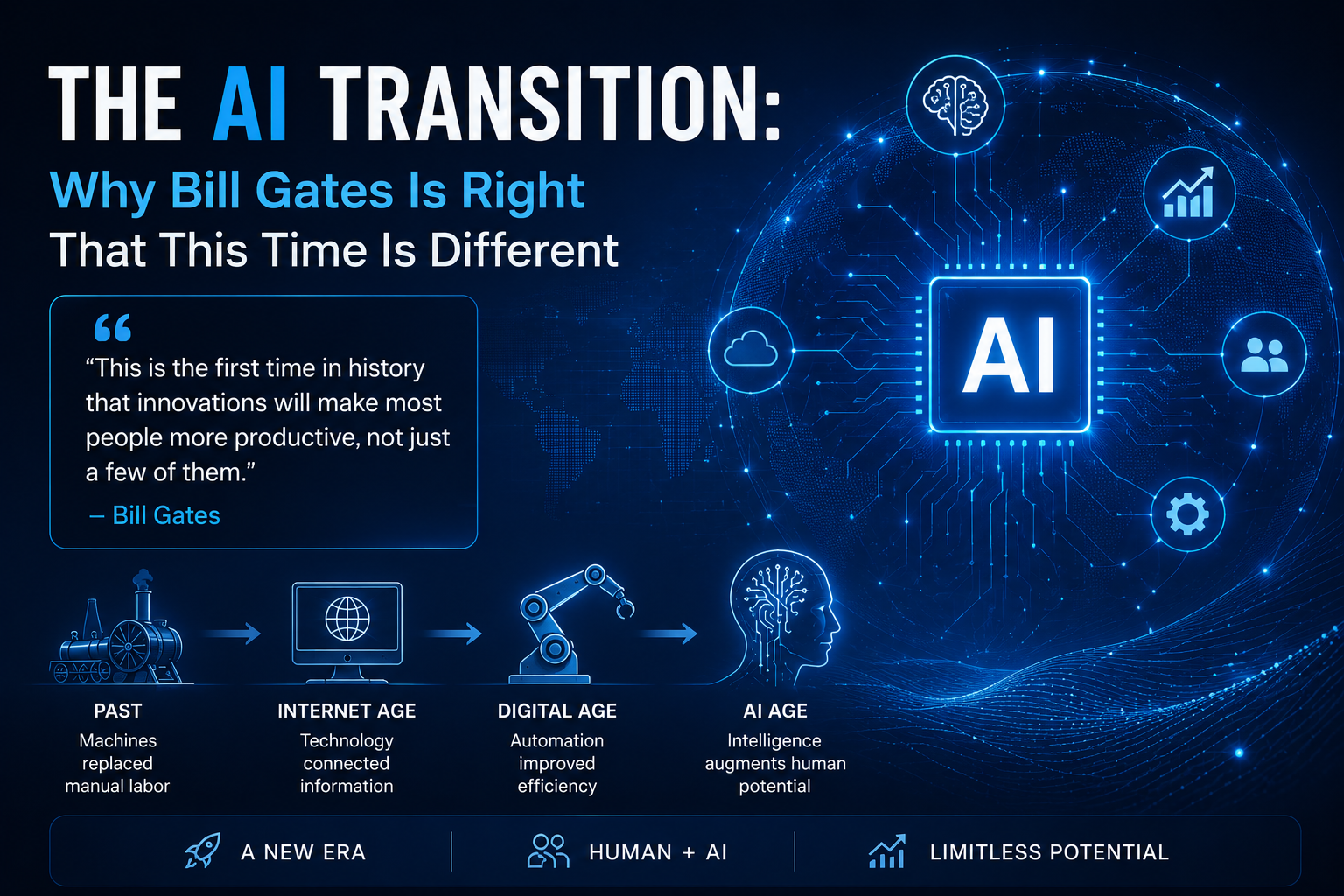
For most of modern history, every major technological disruption has come with the same reassurance: we have been here before. The Industrial Revolution displaced physical labor, but it also created factories, industries and entirely new categories of work. Computers eliminated some jobs while creating software developers, IT departments, digital marketers and an information economy. The internet disrupted everything from newspapers to retail, while simultaneously creating businesses and professions we could barely have imagined a generation earlier. So when concerns about artificial intelligence and jobs arise, it is tempting to reach for the same familiar conclusion: technology changes work, people adapt, new industries emerge and ultimately we create something new. But on August 26, 2026, Bill Gates published an essay on GatesNotes titled “The Turbulent AI Era Is Here. The Choices We Make Now Are Critical .” In it, Gates makes a much more provocative argument about the moment we are entering. He warns that AI is not simply another chapter in the long history of technological disruption and that society is not adequately preparing for the transition ahead. One section of his essay is titled with five words that immediately caught my attention: “This time really is different.” That idea is the starting point for this essay. What follows is not an attempt to predict the future with certainty, nor do I agree automatically with every policy solution Gates proposes. Rather, his essay raises a set of questions that I believe business leaders, policymakers, educators, workforce leaders and communities need to wrestle with now:
By Jonathan A. Liebert • August 19, 2026
Recently, I had the privilege of testifying before the U.S. Senate about artificial intelligence and its transformative impact on the modern workforce. It was an opportunity to discuss an issue that is quickly becoming one of the defining economic questions of our time: What is AI actually going to do to jobs? The conversation around artificial intelligence often gravitates toward extremes. On one side is the promise that AI will dramatically increase productivity and create entirely new industries. On the other is the fear that automation will eliminate millions of jobs. The reality emerging from the data is more complicated — and, in many ways, more interesting.  Through leading the BBB AI Hub and training thousands of business owners, nonprofit leaders and workers on the responsible use of artificial intelligence, I have come to believe that AI literacy is increasingly becoming the difference between leverage and liability. I have watched people use AI to organize complex information, improve communication, accelerate research, analyze data and turn ideas into action faster than ever before. I have also watched people enter sensitive customer information into public AI systems, accept fabricated citations as fact, rely on biased or incomplete outputs and purchase products labeled “AI-powered” without really understanding what the technology does. The opportunity is enormous. But so is the responsibility. And nowhere is that becoming more evident than in the workforce.

2026 Global AI Jobs Barometer
August 14, 2026
PwC’s 2026 Global AI Jobs Barometer goes beyond the question of whether AI will “take jobs.” It explores how AI is changing the structure of work itself and what those changes could mean for employers, employees and people just entering the workforce.

August 12, 2026
Someone on your team has probably figured out a good way to use AI. Maybe it helps compare requirements against a deliverable, organize closeout documents, prepare an action log, or summarize project reporting. The prompt works. The result is useful. The person who built it knows exactly what to provide, how to phrase the instructions, and what needs to be checked afterward. Then someone else tries to use it. That is usually when the team discovers that a good prompt is not yet a repeatable construction workflow. The second person uploads the wrong version of the specifications. The output comes back in a different format. A requirement is missed. Nobody knows whether the AI used the contract, the addendum, or the folder labeled: FINAL — USE THIS ONE The problem is not necessarily the AI. The process was never fully defined.